World No Tobacco Day: Quit Tobacco Naturally
Stress Relief and Wisdom: The Timeless Lessons of the Bhagavad Gita
Beyond the Medicine Cabinet
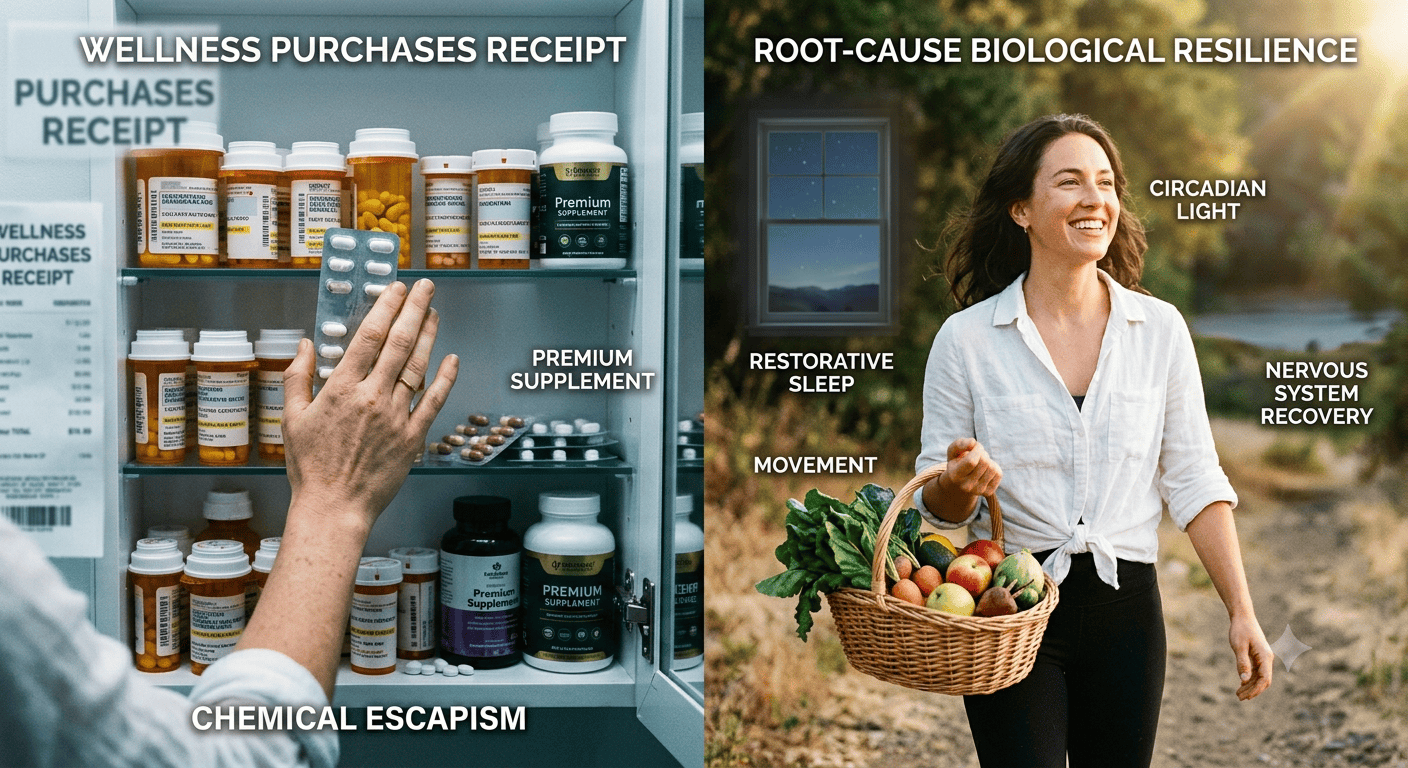
In modern society, health is frequently confused with the absence of acute illness or the stabilization of lab results. We live in an era where a quick visit to the pharmacy or a cabinet full of premium dietary supplements is marketed as a proactive health strategy. Yet, despite record-breaking spending on pharmaceuticals and wellness products, rates of chronic fatigue, metabolic dysfunction, and lifestyle-related diseases continue to soar.
The fundamental reason for this disconnect is a widespread misunderstanding of what medicine and supplements actually do. Health is an active state of physiological harmony and biological resilience—and it cannot be bought, swallowed, or synthesized in a laboratory.
1. Medicine Manages Disease; It Does Not Create Health
Modern pharmacology is one of humanity’s greatest achievements when it comes to acute care, emergency intervention, and symptom control. If a person suffers a severe infection, experiences a cardiac event, or suffers traumatic injury, medicine saves lives. However, when applied to chronic health conditions, medicine operates on a model of management, not creation.
Symptom Suppression vs. Functional Repair
A blood pressure medication can mechanically relax blood vessels to lower a numerical reading on a monitor, but it does not fix the arterial stiffness, chronic inflammation, or metabolic dysfunction that caused the pressure to rise in the first place. Similarly, a drug for type-2 diabetes artificially lowers blood glucose levels, but it does not restore insulin sensitivity or reverse cellular overload.
Medicines are designed to alter chemical pathways to prevent a system from crashing. They maintain the disease at a manageable level, keeping the body in a state of suspended animation so that symptoms do not become immediately fatal. Equating the management of a disease with the attainment of health is like confusing the repair of a leaking roof with building a solid foundation.
2. The Supplement Industry: A Commercial Solution to a Lifestyle Problem
In response to the limitations of prescription drugs, the multi-billion-dollar nutritional supplement industry presents itself as the natural, proactive alternative. Millions of people swallow daily multivitamins, synthetic minerals, and concentrated extracts under the belief that their health issues stem from a simple shortfall of nutrients.
This paradigm overlooks a basic biological truth: nutrient deficiencies in the modern world are rarely caused by an absolute lack of nutrients in our proximity. They are almost always caused by an inability of the body to properly digest, absorb, and cellularly utilize those nutrients due to continuous lifestyle strain.
| Deficient State | Popular “Pill” Solution | The Actual Root Cause (Lifestyle & Environment) |
|---|---|---|
| Low Vitamin D | High-dose synthetic D3 softgels | Lack of direct sunlight exposure, circadian disruption, and chronic low-grade inflammation. |
| Iron Deficiency / Anemia | High-dose iron tablets | Poor gut lining integrity, low stomach acid from stress, or chronic systemic inflammation suppressing absorption. |
| Low Energy / B-Vitamins | B-Complex shots & energy pills | Sleep deprivation, overstimulation, excessive refined sugar intake, and chronic sympathetic nervous system activation. |
| Digestive Issues | Probiotic capsules (50+ Billion CFU) | A diet high in ultra-processed food, lack of dietary fiber, high alcohol consumption, and unmanaged psychological stress. |
Swallowing an isolated nutrient pill while leaving the gut microbiome damaged, the circadian rhythm destroyed, and the nervous system chronically elevated is biologically inefficient. The body is an integrated ecosystem, not a container into which you can dump synthetic compounds and expect metabolic balance.
3. The True Root Cause: We Cannot Escape Our Daily Choices
The modern epidemic of poor health is not a deficiency of drugs or dietary supplements; it is a mismatch between human evolutionary biology and modern lifestyle habits. The body requires specific, foundational biological inputs to thrive:
- Circadian Synchronization: Regular exposure to natural morning light and darkness at night to govern hormone production, melatonin synthesis, and cellular repair.
- Whole-Food Nutrition: Complex, nutrient-dense real foods that require active digestion, supporting gut microflora and steady glucose regulation.
- Consistent Physical Movement: Mechanical tension, cardiovascular output, and daily locomotion to transport lymph, maintain muscle tissue, and clear cellular waste.
- Restorative Sleep & Nervous System Recovery: Deep sleep to allow the brain’s glymphatic system to clear toxins and the cardiovascular system to reset.
When these foundational inputs are ignored, the body develops symptoms—fatigue, brain fog, metabolic slowing, high blood pressure, and hormonal imbalances. These symptoms are not errors or random defects; they are the body’s logical, adaptive responses to a hostile environment created by sedentary living, ultra-processed food, constant artificial lighting, and chronic stress.
4. The Hazard of Chemical Escapism
Relying on medicines to manage symptoms and supplements to offset poor habits creates a dangerous psychological feedback loop: chemical escapism.
When a person takes a pill to lower their cholesterol, a supplement to give them artificial morning energy, and another pill to force sleep at night, they are granted a false sense of security. They are persuaded to believe that their lifestyle choices are being “canceled out” by their regimen.
No amount of Vitamin C can compensate for six hours of broken sleep. No high-end probiotic can undo the damage of a diet built on ultra-processed oils and refined sugars. No blood pressure medication can neutralize the physiological impact of a sedentary, stress-filled existence.
5. Reclaiming Biological Balance: Actionable Steps for Gut and Metabolic Repair
If health cannot be swallowed in a capsule or written into a prescription, how do we systematically repair a damaged gut and a sluggish metabolism? The answer lies in engineering an environment that allows the body’s innate self-healing mechanisms to function. Rather than seeking external chemical intervention, restoring gut integrity and insulin sensitivity requires aligning daily habits with human biological design.
Before attempting to “heal” the gut or boost metabolism, you must stop active damage. Ultra-processed foods contain synthetic emulsifiers (like carboxymethylcellulose and polysorbate-80), artificial sweeteners, and heavily refined seed oils.
Mechanism Emulsifiers erode the protective mucous layer of the intestine, allowing bacteria to contact the gut wall directly and triggering systemic inflammation. Meanwhile, constant exposure to refined sugars overworks the pancreas, promoting insulin resistance.
Action Shift exclusively to single-ingredient whole foods. If a product contains ingredients you would not find in a home kitchen, it does not belong in a body attempting to repair itself.
Capsules containing billions of colony-forming units (CFUs) often fail to colonize the gut because the intestinal environment remains inhospitable. The most effective way to build a robust gut microbiome is to feed the beneficial bacteria already present.
Mechanism When gut bacteria ferment dietary fiber and polyphenols, they produce short-chain fatty acids (SCFAs) like butyrate. Butyrate repairs the intestinal lining, reduces gut permeability (“leaky gut”), and signals metabolic pathways to improve insulin sensitivity.
Action Aim for a wide diversity of whole plant foods each week—legumes, root vegetables, leafy greens, nuts, seeds, and traditional fermented foods (unpasteurized sauerkraut, kimchi, plain kefir).
The gastrointestinal tract operates on a biological clock. Digestion, enzyme secretion, and gut motility are tightly governed by light exposure and regular timing.
Mechanism When you eat constantly from early morning until late at night, the digestive system never enters its maintenance phase. During fasting windows, the gut initiates the Migrating Motor Complex (MMC)—a mechanical sweep that clears residual food and bacteria from the small intestine, preventing bacterial overgrowth (SIBO).
Action Establish a consistent 10- to 12-hour eating window (e.g., 8:00 AM to 6:00 PM) and avoid all calories for 3 to 4 hours before sleep. Give your gut at least 12 continuous hours of physiological rest every night.
Metabolic health relies heavily on how efficiently your body clears glucose from the bloodstream. While pharmaceutical drugs attempt to forcibly manipulate insulin levels, physical movement clears glucose through a completely natural pathway.
Mechanism Contracting muscle tissue activates GLUT4 transporters, which pull sugar out of the bloodstream and directly into muscle cells without requiring additional insulin.
Action Take a 10- to 15-minute light walk immediately after your main meals. This simple habit drastically dampens post-prandial blood sugar spikes, reducing metabolic strain on the liver and pancreas.
The enteric nervous system—often called the “second brain”—is intimately tied to your central nervous system. Digestion is an explicitly parasympathetic process (“rest and digest”).
Mechanism When you eat while stressed, rushed, or staring at screens, your body remains in a sympathetic state (“fight or flight”). Blood flow is diverted away from the digestive organs, stomach acid production drops, and digestive enzyme activity plummets, leading to malabsorption, bloating, and food intolerances.
Action Practice 2 minutes of slow, deep diaphragmatic breathing before eating. Sit down, chew food thoroughly (20–30 times per bite), and eliminate screens during meals to enable optimal digestive secretions.
Core Conclusion: Health as a Daily Biological Practice
Health is not a commodity that can be manufactured in a factory and distributed in a bottle. Medicines remain essential tools for acute crisis management, and isolated nutrients can serve specific, targeted medical needs under professional care. But as a strategy for daily well-being, relying on them creates a false sense of control while the underlying lifestyle breakdown continues unchecked.
True health is the biological reward for respecting your physiology. By nourishing the gut with real food, honoring natural circadian rhythms, moving consistently, and managing stress, you address the root cause of metabolic and digestive disease—building a resilient foundation that no pill can replace.